
Where there are living flows, there is life.… The flow of water from the ocean to the clouds to the snowpack at the top of mountains to the rivers. The flow of blood through the veins of our body, which itself is over 60% water. The flow of energy and money through our society. The flow of care and goodwill in our communities. The flow of knowledge and experience across generations. The flow of stories we tell ourselves and each other about the past, present, and future.
We're in a critical moment in human history, unlike anything that has ever happened before. Humanity lives within two interlinked systems: the biosphere and global civilization. Together, they are the life support system for all humans. For the first time in history, the structure of our growing global civilization is undermining the living systems upon which it depends. We must create a bridge – be a bridge – between them. Those who hold and steward wealth have a sacred responsibility to enable funding to flow in a way that actually meets the entangled challenges. There is a narrow window to do so. We're calling on philanthropists to help reshape the way work is organized on the ground and the way we flow funding into it.

This is about social and ecological regeneration writ large, whole-system work for ecopsychosocial wellbeing. It's far bigger and more profound than just "nature solutions," supporting "social programs," or "choosing strategic priorities." It's about living into a fundamental new/old story. We need better strategies for our stories, better ways of choosing which stories we live into being and which ones no longer serve us. If the story we need doesn't exist yet, we need to manifest it, to guide it into being – with wisdom, conscience, and care. This is where Living Flows comes in.
To oppose something is to maintain it.… You must go somewhere else; you must have another goal. Then you can walk a different road.
— Ursula K. Le Guin, American author
Sometimes you are born into the ending of a world. The story you were born into doesn't have much further to run. The future no longer works. What moves are worth trying, in such a time? First, as far as you can, stop trying to make sense according to the logic of the world that is ending. Then start trying to make good ruins, to release materials from the structures of that ending world, materials that could be put to use in the building of worlds we can't even imagine yet.
— Dougald Hine, British author
Flowing out of decades of research and practice by the stewards of Bioregional Earth, we're creating multicapital flows for ecological and social regeneration. Living Flows enables robust translocal action scale-linked into a strategic large-scale framework, letting life do its thing in complexity and emergence.
A Living Flows approach is grounded in learning from all the living flows of Earth. Water is life, and the flow of water, for example, has much to teach us: "Falling raindrops show us how something so soft can, over time, wear away stone… Water does not stop because it encounters obstacles. It finds another way. If it cannot move in a straight line, it flows in curves day and night, without ceasing, always moving forward to the sea."
A Living Flows approach rethinks what learning is and how it becomes part of an ongoing process. It reorganizes work on the ground into tapestries of projects that reinforce and multiply the effectiveness of any single effort. And it pools funding and flows it in and around and over where it's needed in any given moment.
Dandelion and Ripple are the two complementary strategies of Living Flows, each moving across fractal planetary scales from different directions – large (planet) to small (place-based activities) and small (bioregion) to large (bioregions around the planet).
Funders worry about ensuring that money is spent well. How can you be part of a whole system in which it's inevitable that money will be spent well? It is in Living Flows that we find the returns that really matter in this moment – Return of Legacy, revealed in lifetimes across generations.
The River of Life is in Trouble
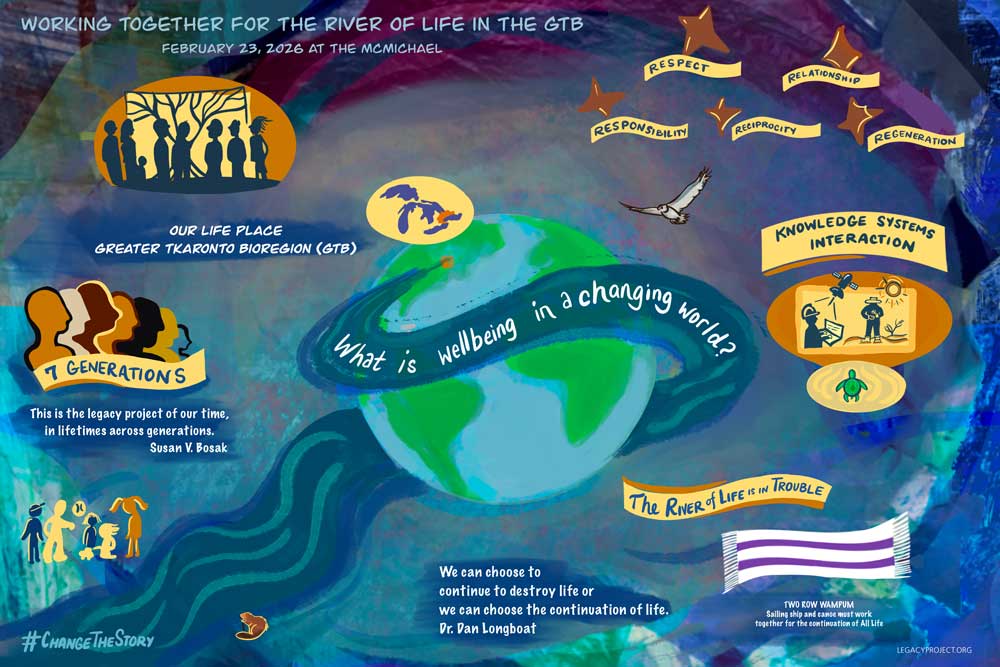
Living Flows was born at a milestone gathering in the Greater Tkaronto Bioregion (GTB) in February 2026.
The culmination of several years of relationship-building, "Working Together for the River of Life" was an intergenerational, cross-silo gathering that brought together international guests, social thinkers and scientists, Indigenous Knowledge Holders and Elders, conservation and restoration practitioners, and youth leaders. It was convened and co-facilitated by Susan Bosak and Brian Puppa (Legacy Project as the GTB Core Team, Co-Stewards of Bioregional Earth), Joe Brewer and Penny Heiple (Co-Founders of the Design School for Regenerating Earth, which is part of Earth Regenerators, and Co-Stewards of Bioregional Earth), and Dr. Dan Longboat (Associate Professor and Co-Founder, Indigenous Environmental Institute, Trent University, and a collaborator on Bioregional Earth).
The intention was to honor the River of Life and make a commitment to work together – across cultures, silos, and generations – to care for it and each other into the next seven generations.

What is wellbeing in a changing world? The River of Life is dying. The Two Row Wampum belt (bottom right of sketch) from the Great Lakes in North America has two rows of purple beads running alongside each other, representing two vessels: the canoe (Indigenous) and the sailing ship (settlers), each with their own ways. The vessels travel side-by-side down the River of Life, separate and distinct yet together. But now, the River of Life is in trouble. The canoe and the ship must work together for the continuation of All Life. Living Flows is founded on knowledge systems interaction: Western science and Indigenous Knowledge. It's also founded on a systemic process that must begin with respect (largest star in top right) for the land (in the broadest sense), ourselves, and each other. Through right relationship we feel into our responsibility and opportunities for reciprocity. Only then are we able to take authentic regenerative action as we #ChangeTheStory.
The existing funding architecture – philanthropic, governmental, and increasingly impact investment – is organized around the paradigm the field is trying to supersede. It funds programs with measurable outcomes, organizations with proven models, interventions with clear theories of change… But [the work that's really needed] is simultaneously embodied and systemic, rooted and networked, spiritual and economic, local and globally informed. The very richness that makes the field generative is what makes it hard to fund by conventional means.
— Jenny Andersson, Paideia Inquiry
Suffused by the varied voices at the River of Life gathering, we had several days of strategic meetings to begin shaping Living Flows. We could see from the gathering, as well as our own years of on-the-ground experience, that funding was not flowing where and how it needed to flow. The gathering also underscored, from the perspective of differing cultures and generations, that the future must be bioregional. The 2025 polycrisis modeling done by Cascade Institute should be of interest to every philanthropic funder. It offers an analysis that leads to only a single scenario, out of over 4 million, that's good for humans: prosocial, local regenerative economies grounded in bioregions (the only actionable scale that maintains whole-system integrity). But this analysis on its own doesn't offer a strategy. Living Flows is a strategic approach that can begin to counter cascades of collapse with cascades of resiliency at a very deep level – not only coping with a changing world, but living into a new world that respects All Life.
At the River of Life gathering, Dr. Dan Longboat commented on Chinese philosopher Lao Tzu's well-known saying that you can "feed a man a fish and you feed him for a day; teach him how to fish and you feed him for his lifetime." Longboat added that "teach human beings their sacred relationship to fish and you will have human beings and fish until the end of time."
Creating Funding Ecosystems

Joe Brewer has been doing regenerative work in Colombia since 2020, exploring how to create funding ecosystems.
In the real world (as opposed to the abstract theories we often use), everything is connected to everything else. How do we act in that reality? First, you can't look at economy or education or environment or social equity separately. A whole-system approach is transcontextual. Nora Bateson talks about the problem with "solving problems." Every issue, situation, or phenomenon exists within multiple contexts simultaneously. These contexts are interwoven, each influencing and being influenced by the others, a swirl of casualities moving backward and forward in time. Traditional approaches to understanding a complex reality often fail because they isolate contexts, addressing them separately as "problems" rather than as one large, interconnected whole. A whole-system approach embraces uncertainty and ambiguity, understanding that there are no easy answers or clear-cut solutions. It’s more relational, dynamic, and responsive to the complexities of life – like an ecosystem.
Brewer's ecosystem model emphasizes that financial flows must always be embedded in the ecological flows that support life. He centers an evocative tree shape with interconnected branches: learning, a portfolio of interconnected social/ecological projects (across themes like environment, education, health, food, local economy, etc.), and funding – all in relationship and mutually informing each other. This forms the basis for Living Flows as a way to organize work on the ground and flow funding into it, all the while being in an ongoing process of learning and emergence.
Living Flows is informed by years of research and practice by Brewer, Heiple, Bosak, and Puppa. For example, we created a three-part video series, Creating Bioregional Funding Ecosystems, as a candid, pragmatic, in-depth look at the theory and practice of funding regenerative work in bioregions. We also ran the Regenerative Finance Forum.
One question that often comes up is, how does this scale? It fractally scale-links (like Ukrainian nesting dolls), honoring the unique context of each bioregion and how each bioregion is in relationship with the larger planet. Scale-linking happens through common themes across bioregions supported by a Living Flows approach to funding.
Structure and Flows
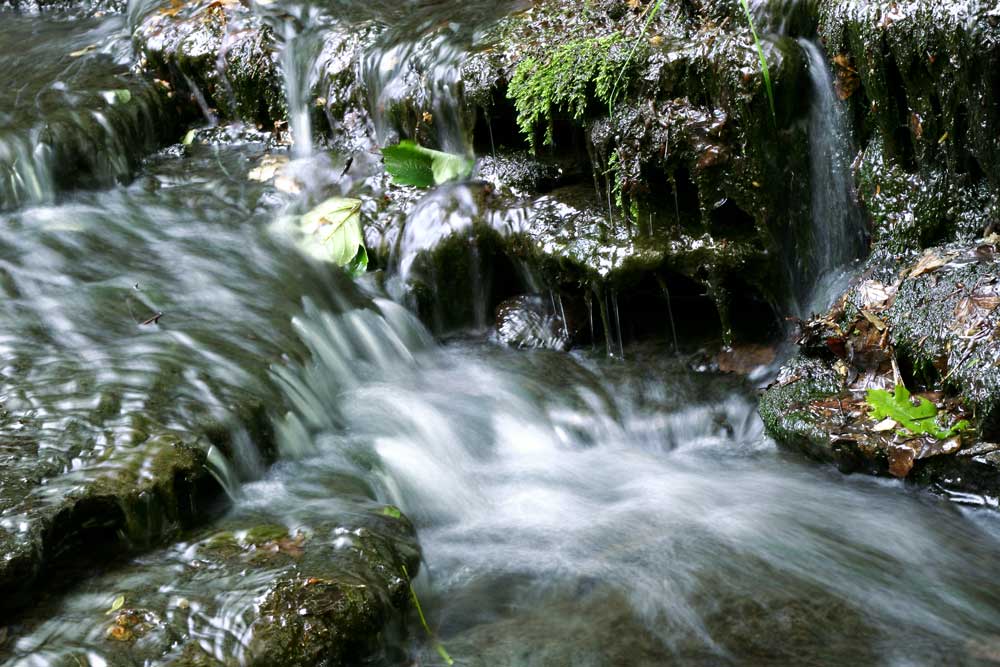
This image captures the essence of Living Flows in many ways. The structure of the rocks determines the flow of the water, and simultaneously the water can reshape (erode) the rocks. They are in relationship.
In the same way, how we organize work on the ground and flow funding (and other forms of capital) through it are interrelated – and funders must be active participants in the relationship. A Living Flows approach is created on a foundation of life place as a real-world, whole system in which we're continuously learning how to take the next best step.
What this looks like in practice is that philanthropy funds at the scale of the bioregion, our "life place," which is fundamentally what's "real" as a holistic bundle of local land and life features/processes along with dimensions of human culture (we both shape the place we live and are shaped by it). A bioregional approach is both a way of doing things and a way of thinking – a terrain of geography AND a terrain of consciousness. The bioregion is a concrete, real-world pathway (geography) toward right story (a shift in consciousness). We can learn from and be/act in right relationship with the land, and in doing so it shifts our consciousness. Scientific research tells us that consciousness doesn't shift in the "mind," but through embodied action in relationship. The physical place enables us to get to a better cognitive place. That's what makes the bioregion the smallest actionable scale that maintains whole-system integrity for ecopsychosocial wellbeing. In that whole-system context, funding supports enabling conditions like a Core Team and some or all of an interconnected portfolio of social/ecological projects. Everything organized so that it flows into and out of the scale of the bioregion.
Philanthropy funds the whole system. Projects are embedded in a web of relationships between people and the land – a living developmental field. There may be themes – like education, health, economy, ecological restoration – but a single project will touch multiple themes at any given time, even moving through different themes as it evolves. Projects benefit from mutual support structures and the support of the Core Team, financial and other forms of capital, and synergies between initiatives. When investments reinforce one another within a bioregion, a portfolio can become more than the sum of its parts. This whole-system work is coherent and multiplies long-term effects. As people are empowered in their place, they become better able to work together at the speed of caring for life. This is a powerful counterbalance to societal forces of separation and technology, especially AI.
Philanthropy enables the emergent flexibility to take the next best step – in the right direction. In complexity, where everything is connected to everything else in an intermeshed tangle, we can only take the "next best step." After each step, we continuously course correct through lived experience and learning. It's important that any "next best step" not be pulled into wrong story, but maintain integrity toward right story. This is where unrestricted, long-term funding, with no expectation of financial returns, is critical, because it enables practitioners to step outside the existing system of economic wrong story (i.e. immediate, measurable returns).
We can only be in right relationship with ourselves and each other if we're in right relationship with the land. We need Living Flows funding that actually operates like the living Earth system. From this rich, complex approach flows multilayered ways to monitor effectiveness.
Working to #ChangeTheStory
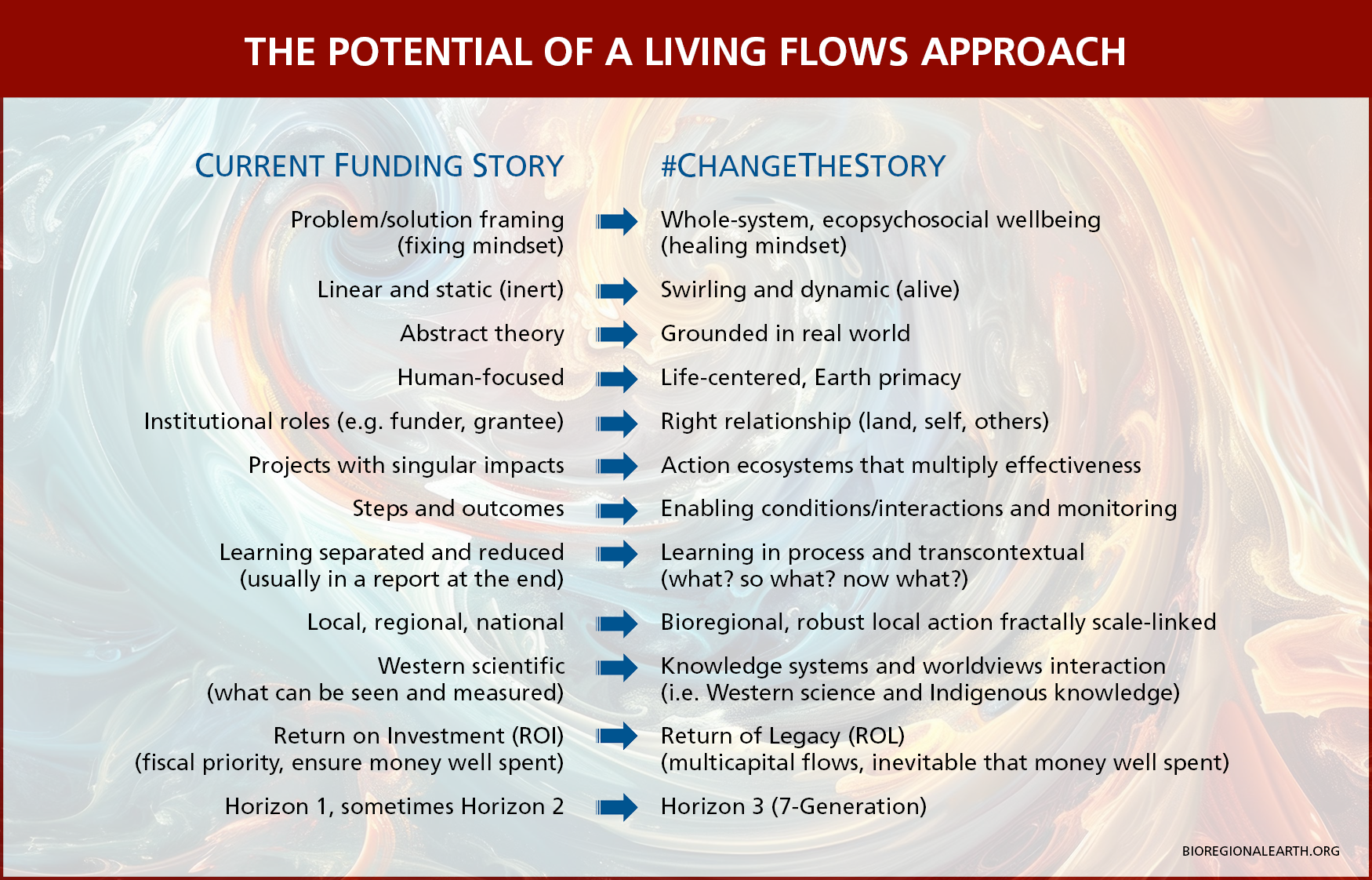
The Living Flows approach has been carefully designed and developed to meet this global moment. It holds significant potential. This chart highlights the ways we're working to #ChangeTheStory around funding. What it asks of funders and philanthropists is to experiment with shifting from the current funding story – to create something in right relationship that's more emergent, responsive, grounded, life-centered and, ultimately, effective.
Many philanthropists and funders are well-intentioned. But it's not obvious how to effectively flow money, especially in these times. You may be doing vital and deeply important work. But what is it really building toward? How are you scaffolding genuine transformation as we cross tipping points of the Earth and cascade deeper into social and planetary collapse? What's your money doing to coordinate toward the social and ecological regeneration we need so that our species has a viable future?
We're doing an initial raise of $10 million for a fund that continues to bring Living Flows to life, through the Dandelion and Ripple strategies. We already have an anchor donor. Contributing to this fund offers you several benefits:
- Working with field leaders who are directing the fund and have the expertise, passion, and relationships to flow money wisely into work on the ground. You do not have to build your own in-house expertise or staffing. We can support the staff you have with learning opportunities that are personally and professionally transformative, strategic guidance, connections, and other non-monetary benefits.
- You can experiment with and direct some of your philanthropic capital while maintaining your other pursuits. Living Flows enables philanthropists to move rapidly into new, systemic areas without having to first build internal capacity.
- Learn and evolve with other funders and on-the-ground practitioners, as well as across knowledge systems (i.e. Western science and Indigenous worldviews/knowledge). There are opportunities for real-world immersions that connect head, heart, and hands in authentic ways.
- A type of scalability (fractal scale-linking) that goes beyond traditional giving. Philanthropists often have a small number of investees with whom they maintain direct and active relationships. That approach typically hits diminishing returns at relatively modest levels ($10-100 million per year). This is because there are only so many relationships individual philanthropists can effectively maintain and there's only so much funding a small set of investees can effectively absorb. By instead maintaining relationships with the Living Flows field leaders, who themselves maintain dozens of relationships, philanthropists can deploy more of their wealth without a drop-off in effectiveness. For those committed to giving away significant wealth in their lifetimes, this kind of scalability is crucial.
- The field leaders are able to empower grassroots decision-making, which lessens the burden on individual funders. Donors act as the philanthropic equivalent of limited partners. You may contribute your network and expertise – for example, helping to raise additional funds – but you ultimately trust the field leaders on disbursement of the Living Flows, allowing those flows to remain alive in the field. This is particularly important when achieving an ambitious vision that requires a portfolio of mutually reinforcing projects, as opposed to a set of disconnected projects chosen by different funders participating in a donor collaborative.
- Evocative and provocative storytelling for stakeholders, boards, and the public – that's how we #ChangeTheStory.
- This is big-picture legacy work, and gives funders an opportunity to reach beyond the short timelines they usually pursue. The appeal of Return of Legacy is significant. We're bringing money alive, flowing it out of existing dying systems and gifting it into a life-affirming future.
The bottom line is that money can't flow effectively if right relationship doesn't flow at the same time. We invite you into relationship to be part of Living Flows.
Flowing Right Relationship for Right Story
There is nowhere near enough awareness of the severity of our current predicament among decision-makers in philanthropy. And there isn't enough awareness of what they have the power to enable. We recognize it can be difficult to discern how to effectively flow money in these times. This is why we're working with those who hold and steward wealth.
It's one thing to know the facts intellectually – like the fact that we've crossed seven out of nine planetary boundaries. If you interpret this in strictly financial terms, the Institute and Faculty of Actuaries (IFoA) came together with the world's leading climate scientists to do an analysis. These are risk assessors, conservative by nature. They came out with a Planetary Solvency report. Their blunt conclusion: "There is an increasing risk of Planetary Insolvency unless we act decisively. Without immediate action to change course, Catastrophic or Extreme impacts are eminently plausible… It will be overwhelmingly positive economically to avoid Planetary Insolvency. An urgent response is required."
You can hear all those facts. But it's another thing to allow that knowledge to permeate and transform the substrate of your thoughts, emotions, and actions. In the face of discomfort and fear, we tend to retreat back into the familiar rather than risk standing at the edge of the unknown.
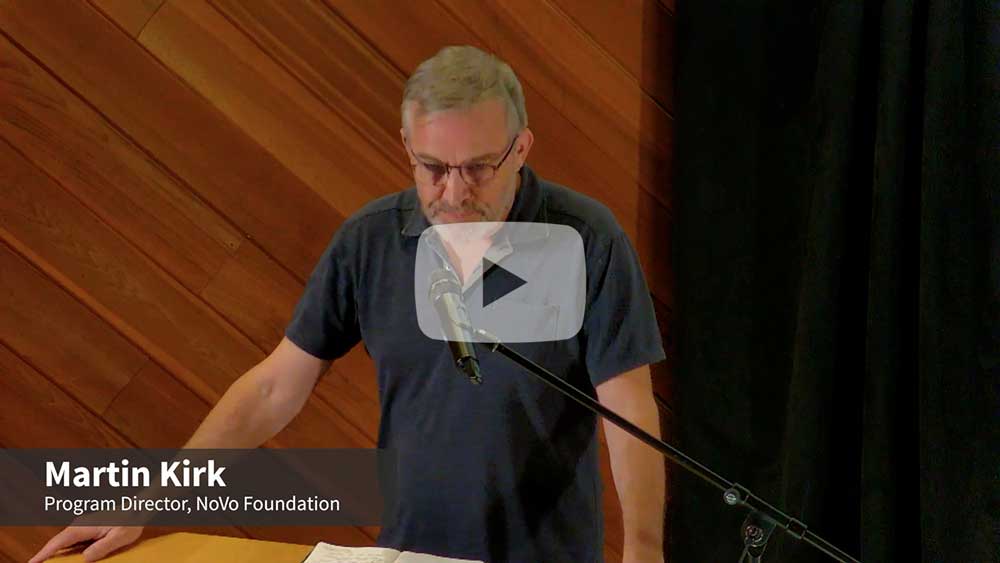
This is a candid and straightforward message from one funder to all others out there who hold or steward wealth. We need to find our way back into right relationship – with the land, with ourselves, and with each other – so that we can summon the wisdom to live into the right story. We need to enable "money to flow like water." Where there are Living Flows, there is life.
Bring the energy of the money you hold or steward to Living Flows as we forge a radically different path for philanthropy.
To get more details on the whole-system Living Flows approach, contact us at stewards@bioregionalearth.info.