The heart of the story of Bioregional Earth – the dynamic, whole system of life existing at various fractal scales on this planet – is wellbeing. The concept of wellbeing has to go beyond just indicators of human-centric thriving with a few nods to social and environmental health. It has to be ecopsychosocial: "I" can't be okay unless "we" (family, community) are okay, and we can't be okay unless all living systems around us are healthy now and into the future.
Wellbeing is whole-system work. Whole-system complexity means everything, everywhere, all at once. It requires us to put aside the urge to simplify things, to look for formulas and easy answers. "Doing" it doesn't come from thinking it through, but from feeling our way through. The world is messy. People aren't rational. Relationships are complex. What happens is uncertain. Life unfolds in nonlinear ways, as paradoxes and contradictions abound. Yet, we can find profound meaning, beauty, and possibilities feeling our way through the entangled mess if we put whole-system wellbeing at the heart. Indigenous Peoples have done this for millennia as they've used sophisticated interwoven social and ecological tapestries of story and ceremony, relational protocols and community structures, land-based knowledge, ancestral or spirit memory, and Original Instructions, all in the context of a responsibility to seven generations.
We live in a rainbow of chaos.
— Paul Cézanne
For the first time in human history, we are out of balance with life itself. Ecopsychosocial wellbeing is about finding our way back into balance with life in a timeframe of lifetimes across generations. This looks like social and ecological regeneration (with the bioregion as the smallest unit of action to maintain holistic integrity), with properly circulating Living Flows. This whole-system focus on wellbeing allows for a more complex, long-term, and holistic approach to the environmental and social crises we face. Where we can find personal meaning in all of this is in Return of Legacy, because the legacy of wellbeing is the most profound gift we can give ourselves, each other, and future generations.
What does "ecopsychosocial wellbeing" mean? Ecopsychosocial is a holistic, multidimensional approach to wellbeing. It bridges the Western gaps between the ecological (physical and natural environment), the psychological (mental, emotional, spiritual state, along with physical health), and the social (community, culture, history, relationships).
The term "wellbeing" is grounded as it connotes health and being alive. Terms like flourishing, thriving, or abundance often feel like an oversell, leaning toward utopian visions.
"Psycho" reflects individual beings, originating from the ancient Greek word psykhē, meaning breath, life, spirit, soul, or mind. The word "social" traces back to the Latin word sociālis, meaning companionship or allies. It connotes living with others and the interdependency of all living beings. "Eco" comes from the Greek word oikos, meaning house or environment, or even family and unifying spirit. It serves as the foundation for words related to both living places and processes, as well as natural surroundings. Its dual meaning ties together ideas of community, the environment, and interactions of living entities, emphasizing harmony and balance.
Ecopsychosocial wellbeing is a concept that works to reunite parts that have been artificially separated in the modern world. We tend to organize human activity – and funding/financing that activity – into separated chunks: nature finance, social finance, women's issues, ending poverty, food security, climate change, and so on. Our perception of the world becomes so blatantly wrong that we're blind to the harm we're doing. Our mental models get in the way of seeing how human activity and associated financial flows need to be completely transformed, and that we actually already live in a model of a regenerative economy.
Countering the myth of separation to get back into relationship and balance with all life is a critical foundation of the concept of ecopsychosocial wellbeing. It challenges us to #ChangeTheStory of who "me" is relative to everything that's supposedly "not me."
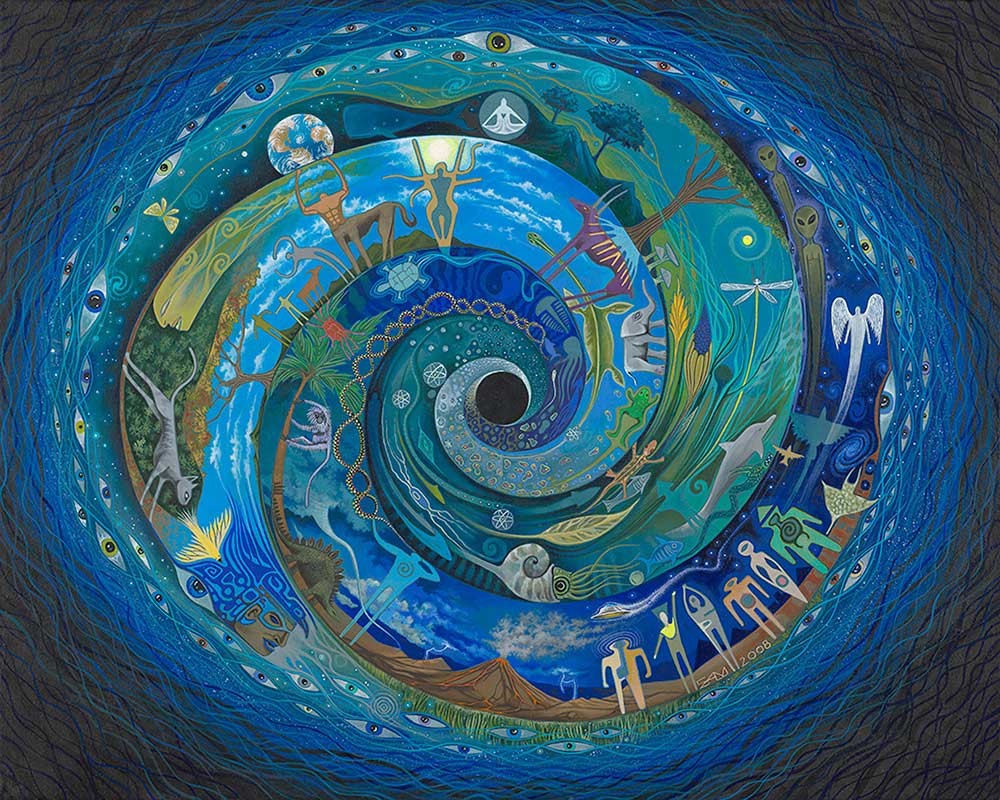
Systems thinker Nora Bateson asks, where is the edge of me? "Finding where exactly the outside world ends and I begin – is not so easy. Do I end at the edge of my skin? Am I the edge of my bank account or my tax ID number? Am I the edge of my family? Am I the edge of my community? My nation? Am I the edge of the biosphere? Where's the edge of me? In that question and that exploration there's a very active shift, and the possibilities of what you can do. Otherwise, you end up in a nasty little paradox: if I do something good for me, it's going to be bad for you. If I do something good for my nation, it may be bad for your nation. If I do something good for my family, it might not be good for a family over there. Recognition of that interdependence, that we are all in, is a shift. And there's another order of questions and possibilities that come out of that shift… That tree is not just a tree. That tree is the culmination and the ongoing entangling of the living processes of hundreds of thousands of organisms – as are you.… We are water. We are air. We grow, we bloom, we seed, we wilt, we die. There is a false separation between humanity and nature. I'm interested in the unprecedented possibilities that come out of that recognition."
When you start to play with the boundaries around "me," you can start to better understand the depth of the concept of ecopsychosocial wellbeing. It is essentially about the wholeness of life in the flow of interrelationship.
Action on behalf of life transforms. Because the relationship between self and the world is reciprocal, it is not a question of first getting enlightened or saved and then acting. As we work to heal Earth, Earth heals us.
— Robin Wall Kimmerer, Potawatomi botanist and author
Indigenous scholar Robin Wall Kimmerer talks about being in right relationship with the land and all other living beings, and how we need to rethink self-interest: "What if your 'self' is permeable? If you see your wellbeing as the same as your family's wellbeing, and your family's wellbeing the same as the wellbeing of the land that feeds us, that changes everything. We live into a story that we are members of this whole beautiful system of belonging."
Getting back into balance with life isn't a passive process. It becomes an intentional, dynamic, ongoing commitment to holistic wellbeing.
There are some concepts that may initially seem to be like ecopsychosocial wellbeing, but they aren't as fulsome in bringing in dimensions like relationships (rather than just interdependence) and spirit (a life force).
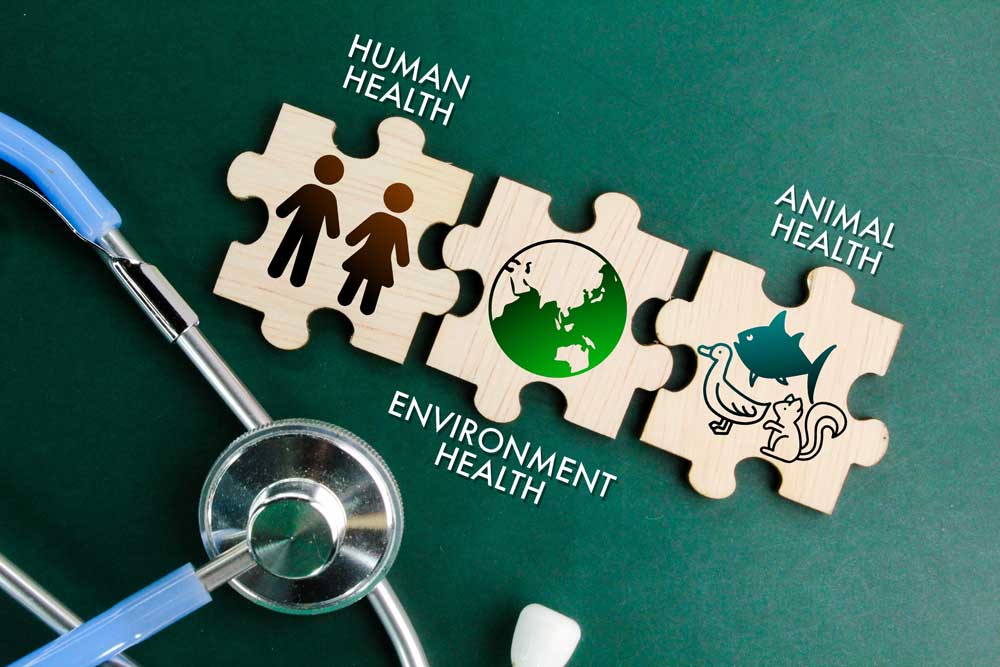
For example, One Health is an integrated, collaborative approach that recognizes the health of people is inextricably linked to the health of animals, plants, and our shared environment. It's largely focused on disease control and food safety.
Another example is that some countries have developed wellbeing indices with various domains. Measurement of emotional wellbeing will differ from, and is separate from, physical wellbeing or economic wellbeing. These indices tend to focus primarily on human wellbeing and how the environment, for example, affects that wellbeing – as opposed to how we are in relationship with everything around us and are just as responsible for the wellbeing of all other living entities.
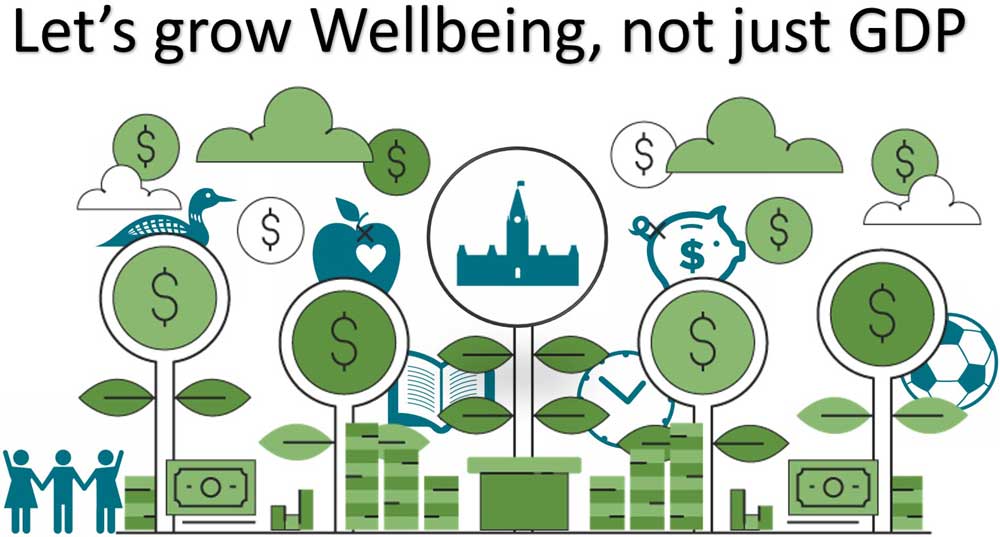
The Organization for Economic Co-operation and Development (OECD) is a forum and knowledge hub for data, analysis, and best practices in public policy. They work with over 100 countries across the world. The OECD Wellbeing Framework helps to monitor societal progress "Beyond GDP" and inform human-centric policy across many domains.
The Canadian Index of Wellbeing (CIW) released its first version in 2011. It defines wellbeing as: "The presence of the highest possible quality of life in its full breadth of expression focused on but not necessarily exclusive to community vitality, democratic engagement, education, environment, healthy populations, leisure and culture, living standards, and time use." These eight domains incorporate a set of 64 indicators that contribute to overall quality of life. Again, there is a human-centered focus across specific domains and indicators, which are measured independently.
It's interesting that the CIW "environment" domain identifies "trends in the availability and use of natural resources in Canada's environment. From the resources that fuel our economy to the medicines that heal us, and the happiness of outdoor enthusiasts to the lessons that guide many religious or spiritual beliefs, the wellbeing of humans depends on the state of the environment. This domain is not an analysis of the sustainability of Canada's environment; instead, it explores natural assets available to Canadians, the flow of these resources over time, and some of the impacts of human activity on the environment."
Viewing the environment as an "asset" and "resource" implies separation, in contrast to the sense of interdependence and right relationship underpinning the concept of ecopsychosocial wellbeing. Real wellbeing across time goes beyond simple structural issues to the ecopsychosocial foundation of our society – who we are, what we value, how we live with each other and all other life on a changing planet.
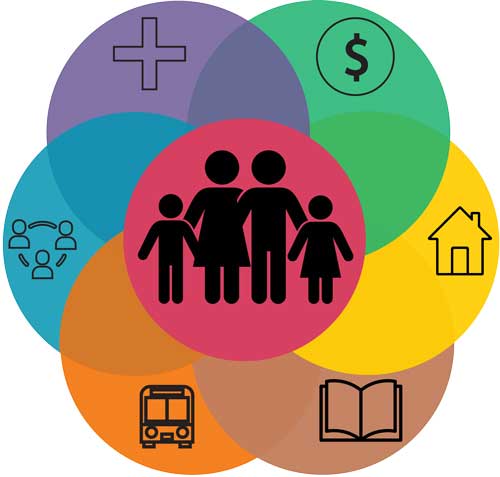
The closest cousin to ecopsychosocial wellbeing may be social determinants of health, used in medical settings to encourage a more holistic understanding of a patient. At least social determinants of health recognizes interconnections between many factors. When someone enters a doctor's office, what ails them is often beyond the simple physical. The factors that make the biggest difference in people's health range from (in order of impact on health, based on research) income status, education, social support networks, and employment to early childhood development, physical environment, personal health practices, genetic factors and gender.
The implication is that we don't have a healthcare crisis, or a youth mental health crisis, or a seniors social isolation crisis, or even a loneliness crisis – we have a systems crisis. Dr. Michael Marmot, Professor of Epidemiology, asks, "Why treat people and send them back to the conditions that made them sick?" The holistic relationships affecting health become more visible. This kind of understanding engages more authentically with a complex reality. Our broader understanding of wellbeing has to do the same.
To talk about "individual wellbeing" is a contradiction in terms. It's not the way the real world works.
The doorway into understanding and acting upon ecopsychosocial wellbeing is the bioregion. The story of Bioregional Earth centers the bioregion as the smallest actionable scale that maintains whole-system integrity for all life. As a holistic scale, a bioregion encompasses all the interrelationships between life, including humans, in a place. The prefix bio comes from the Greek, meaning "life." So, drawing on bioregional pioneer Peter Berg, your bioregion is your life place – the place in which you live your life and which gives you life.
The bioregion is the most powerful scale that interconnects people, communities, and all life on our planet. With a bioregional approach, everything is organized so that it flows into and out of the scale of the bioregion, as bioregions across the planet learn from each other. The bioregion is a concrete, real-world pathway (geography) toward right story (a shift in consciousness).
Somehow civilization has taken a wrong turn and we collectively need to alter our destination, and our journey. We can't drive ourselves to the brink of extinction a second time. If we survive this brink, if we pull ourselves back from this apocalypse that's awaiting, then we have to find a global direction that is one of sustenance and health and beauty for the whole Earth, and for all the living beings of the Earth.
— Ben Okri, novelist and poet
The word "health" comes from the same Indo-European root as "heal," "whole," and "holy." To be healthy, to be well in the fullest sense, is literally to be whole; to heal is to make whole.
Cultural and environmental thinker Wendell Berry defines health as membership in a larger community and natural ecosystem. He argues that true wellbeing connects personal bodies, local communities, and the environment, emphasizing that humans cannot be healthy in a sick or exploited society. "From our constant and increasing concerns about health, you can tell how seriously diseased we are. Health, as we may remember from at least some of the days of our youth, is at once wholeness and a kind of unconsciousness. Disease (dis-ease), on the contrary, makes us conscious not only of the state of our health but of the division of our bodies and our world into parts… Our sense of wholeness is not just the sense of completeness in ourselves, but also is the sense of belonging to others and to our place… We seem to know instinctively that health cannot be divided."
Berry explores the work of English agriculturist Sir Albert Howard, who said that "the whole problem of health in soil, plant, animal, and man [is] one great subject." He goes on to say that "the body is not formally self-contained; its boundaries and outlines are not so exactly fixed. The body alone is not, properly speaking, a body. Divided from its sources of air, food, drink, clothing, shelter, and companionship, a body is, properly speaking, a cadaver." In other words, without ecopsychosocial wellbeing, without being in interrelationship with everything around us, we are not alive.
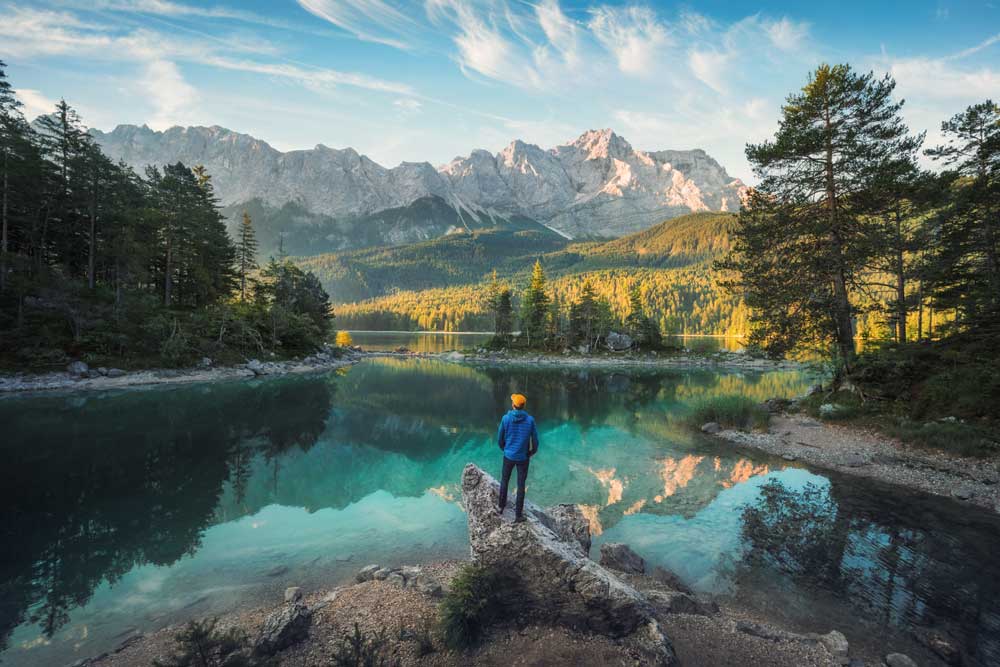
This brings us back to bioregion as our life place. An ecosystem minus one species actually becomes a different ecosystem. Each of us is made up of a unique set of interrelationships wherever we are on the planet. Your wellbeing depends on all your relationships – with yourself, other subjects, and the natural life systems around you. These relationships are nurtured through intention, attention, respect, empathy, and care, which are fundamental to living in harmony with the world. In this way, we can awaken our innate biophilia, the genetically driven human tendency to connect with nature and other forms of life. It's a sense of care, belonging, and co-responsibility toward our life place. In other words, if you want to go inward, you need to go outward. The need for a deeper connection with yourself is intrinsically linked to the need to establish an authentic connection with nature. This also reminds us that the natural world has a significant impact on our quality of life, our mental health, and ultimately our wellbeing.
The story of Bioregional Earth is very much about knowledge systems interaction between the best of Western science and Indigenous knowledge. We settlers (I'm part of the Core Team for the Greater Tkaronto Bioregion and Co-Steward of Bioregional Earth) have much to learn about whole-system wellbeing from Indigenous ways of being and knowing. Two-Eyed Seeing is a concept introduced in 2012 by Mi'kmaw Elders Albert and Murdena Marshall along with scientist Cheryl Bartlett. The concept is valuable for thinking about how we can co-create a collective story of wellness that fosters the ongoing interaction of knowledge systems in a meaningful way.
Since the beginning of colonization, Indigenous Peoples have been trying to communicate to the colonizer that everything is inextricably connected.
— Clayton Thomas-Müller, Cree
Interconnection and relationality are central to First Nations worldviews and ways of knowing. Many use the phrase "all my relations" to express that everything in the universe is connected. The phrase also reinforces that everyone and everything has a role, is worthy of respect and caring, and has a place in the grand scheme of life.
Relationality is the understanding that individuals and communities exist within a vast, interconnected, living web of kinship across time. This goes beyond human family units; rivers, mountains, animals, and plants are considered relatives and are treated with equal care and respect. There isn't a rigid separation between humans and nature, the physical world and the spiritual world – all are part of wellbeing across generations. All living entities, the Earth, and the spiritual realm are woven into one inseparable whole system. It's interesting to note that recent scientific evidence from quantum physics and other fields points to a "living" universe and a convergence of science with universal Indigenous wisdom teachings.
Lindsay Borrows is an Assistant Professor at Queen's University, Faculty of Law, and is a member of the Chippewas of Nawash First Nation. As part of her work, she explores how "rights" of nature aren't enough; we need responsibility to nature. She says, "If we are serious about strengthening our relationships with the living world, we must remember that recognizing rights must also come with understanding our own responsibilities. Indigenous legal perspectives show us a way to expand our collective imagination of what it means to recognize nature's rights by centering responsibilities – to the land, to one another and to ourselves… Elders say, 'laws are for the lawless.' They mean written laws are only needed if we have forgotten the powerful underlying teachings of responsibility that we carry in our minds and in our hearts, passed down generations through stories, ceremonies, songs, art and land-based practices… In Indigenous legal perspectives, law is not only left to specialized judges and legislatures, lawyers and Parliament. Instead, we are all legal practitioners and judges in a sense, with an important role to play in keeping our communities safe, resolving conflict, and building healthy relationships. From this perspective it often makes more sense to talk about responsibilities instead of rights. Elders remind us that we each have the power to create change by carrying laws in our hearts and actions."
Because all entities are interconnected, every action impacts the collective whole. Reciprocity is both a natural law and a daily responsibility. It dictates that humans must only take what they need, and always express gratitude – often through traditional offerings like tobacco – when harvesting medicines, fish, animals, or plants. First Nations know they are stewards of the Earth and their traditional practices support whole-system wellbeing and balance.
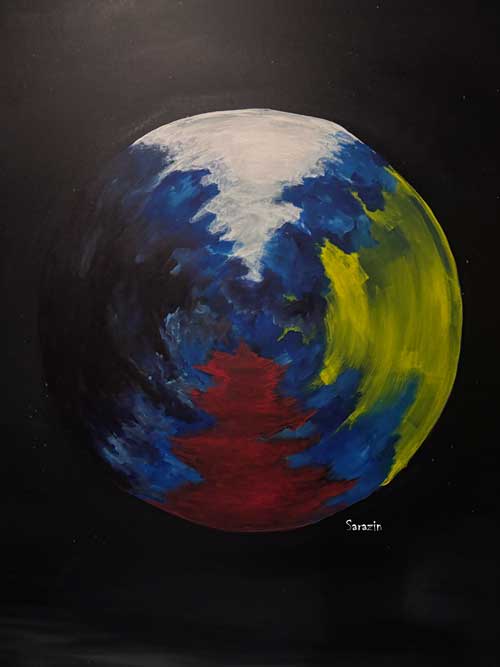
The Indigenous teachings of the Medicine Wheel are a sacred framework. While teachings and interpretations differ among Indigenous Nations, communities and Knowledge Holders, the Medicine Wheel generally represents "balance, connection, cycles and wholeness. It reminds us that all things are interconnected – our spiritual, emotional, physical and mental selves, the people around us, the natural world, the ancestors who came before us and the generations yet to come. The Medicine Wheel teaches us that healing is not linear and that life moves in cycles… The Wheel also reflects the understanding that no part is more important than another. Every direction, every being, and every role within Creation matters. The circle itself is sacred because it has no beginning and no end. It reminds us of continuity, unity, and the ongoing relationship we hold with all living things."
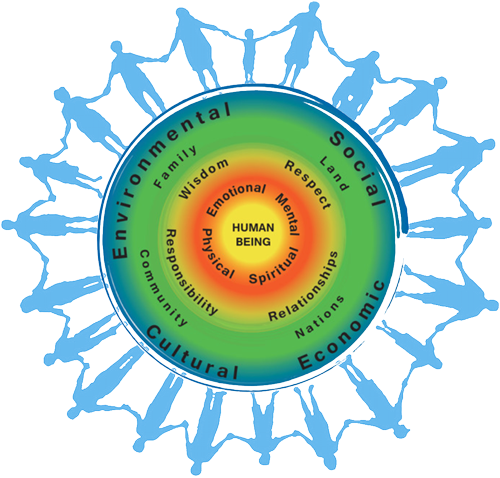
The First Nations Health Authority represents wellbeing in a layered and holistic way. The colors of the sunset were chosen specifically to reflect the whole spectrum of sunlight, as well as to depict the sun's rotation around the Earth, which governs the cycles of life in First Nations.
The central yellow and red circles represent the individual human being. Wellbeing starts with individuals taking responsibility for our own health and wellness. We see the mental, emotional, physical, and spiritual facets of wellbeing in a balanced life. There are four overarching values: respect, wisdom, responsibility, and relationships.
The middle green circle depicts the people that surround us and the places from which we come. Land, family, community, and nations are all critical relationships for our healthy experience as human beings. Land is what sustains us physically, emotionally, mentally, and spiritually. The land is where we come from and is our identity. It's more than just what's under our feet; it includes the ocean, air, food, medicines, and all of nature. We have a responsibility to care for the land and to share knowledge of the land.
The outer blue circle shows the social, environmental, cultural, and economic dimensions of our health and wellbeing. The people are holding hands to show togetherness, respect and relationships which, in the words of one Elder, lead to "one heart, one mind, one spirit."
Tiokasin Ghosthorse, a member of the Cheyenne River Lakota Nation of South Dakota, challenges a familiar line now overused in Western culture, "It takes a village to raise a child." Says Ghosthorse, "It takes the land to raise a child. [This] includes ideas concerning natural conditions, ethics, and protocols based in the Earth communicating and informing cultures about living reality."
Our first relationship is with the land – in the broadest sense of the soil, water, trees and other plants, and all other living entities on a living planet. It's true that nature in itself is "good for us," as much conventional research shows. But relationship with the land goes beyond that. The land is our teacher, it's what's real. When we're in right relationship with the land, we learn how to be in right relationship with ourselves and each other. And that's how we find wellbeing.
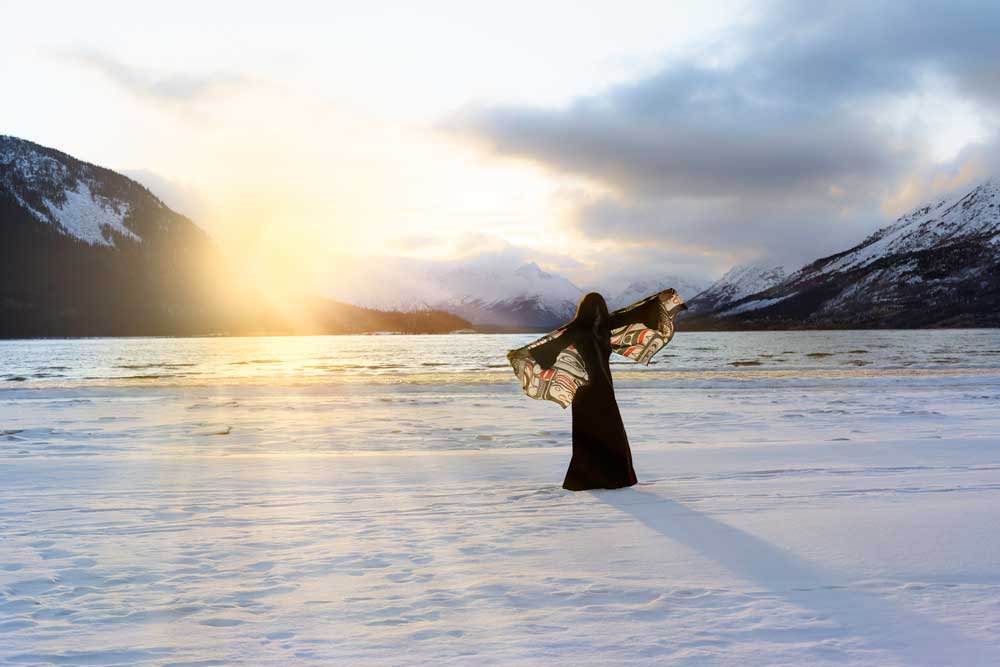
An Indigenous worldview is about being in right relationship (with self, others, the land) within Natural Law for a good life. Natural Law (in Western science terms, the realities of physics and ecology) is derived from fundamental experiences and observations of the natural world. It offers and explains the relationships, responsibilities, and obligations that all forms of life have to one another. A good life is what wellbeing looks like in practice.
Mino-Bimaadziwin, an Anishinaabek worldview that translates to "living the good life," is a profound way of understanding existence and our role within it. True wellbeing is achieved when an individual aligns their physical, emotional, mental, and spiritual self with the natural world and their community.
The holistic philosophy centers balance, interconnectedness, and reciprocity. Balance and wholeness are a continuous, lifelong journey to maintain equilibrium in all dimensions of life (body, heart, mind, spirit). Interconnectedness is about recognizing that everything – plants, animals, waters, and humans – shares a spirit and rely on one another. It's about acting as a steward of Mother Earth rather than a master over her. Reciprocity and generosity place a high value on sharing rather than accumulation. Prestige is often measured by what an individual gives back to their community and how they provide for Elders and the vulnerable. Each individual is responsible for sharing their gifts while meeting mutual obligations to their family, relations, and future generations.
Elder Jim Dumont describes this deep Anishinaabe relationality for wellbeing as "strings of life connecting us to our ancestors and to those yet unborn."
Since ecopsychosocial wellbeing is such a holistic concept, how do we know if we're achieving it, or at the very least working toward it?
To respect the concept, we don't want to get pulled down into reductionistic, short-term metrics and first-order impacts. First-order actions are immediate, direct actions taken to quickly resolve a specific, urgent problem. These kinds of actions are easier to see and measure. Second-order actions are deeper, long-term ripple effects that fully emerge later. They require some wisdom, a sensitivity to context and transcontextuality, understanding whole-system dynamics, and a seven generation perspective.
Indigenous researcher Cindy Peltier shares an insight around measurement from her application of Two-Eyed Seeing. For Anishinaabek, sources of knowing originate from story and ceremony; empirical, observational, and land-based knowledge; knowledge that came directly from the Creator in the form of Original Instructions; as well as what has been described as ancestral or spirit memory. As a "researcher-in-relation," she conveys one experience with an Indigenous community member: "The Anishinaabe-kwe [Anishinaabe woman] initially agreed to participate in my research, but on the day of our visit, she chose not to, and only later would I understand why. On that day, I initially felt that this was a setback since I had driven more than three hours round trip to her home. When I arrived, she very pointedly asked me, 'Can you tell me how this will help us? I've seen so many researchers coming into our communities, but nothing ever changes.' As per her wishes, we did not proceed with the interview, but I gained invaluable knowledge. As with many Anishinaabek I visited, this woman invited me in for tea. When I stepped into her home, I observed that she was overwhelmed and visibly tired as she explained that she was just home from a cycle of cancer treatment. She was in the middle of doing laundry for her grandchildren who were staying with her. On top of all of this, she was busy making wreaths for All Souls Day. In her community, All Souls Day was celebrated with a community feast and the placement of wreaths in honor and remembrance of family members who have passed on to the Spirit World. This woman, a community leader and volunteer, was instrumental in keeping this annual tradition alive. While we visited, I helped her with some of the unpacking and sorting of the dried flowers and craft supplies. She thanked me for the help and the visit."
Peltier did not get an immediate result. But she did support relationship and wellbeing. She comments, "The point was not just to get the interview, but to contribute a tangible (positive) difference for our communities."
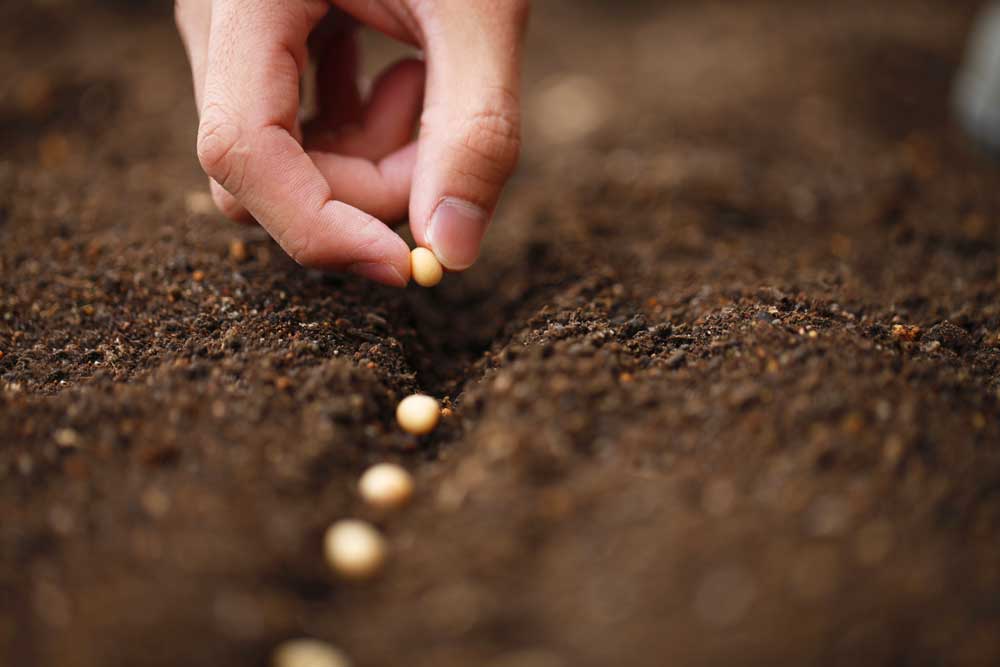
In essence, this becomes about monitoring the seeds you plant. You can only guess what will happen with each seed. But the act of planting them is the right thing to do. The not-knowing, but trusting in what's right, is part of the beautiful mystery and complexity of life.
There is no formula, no method. The realm of possibility is accessed through a sentiment of human care and imagination… Capacity cannot be front-loaded, it is emergent. But it is possible to front-load a baseline perception of self, others and world that assumes the inherent multitude of stories and draws from them… Hope lies in the very fact that as living beings we are wired for relationship. Our humanity is only possible to express in relationship to other human beings and parts of life… Our wellbeing and that of our planet is possible only if we permit ourselves to perceive and embrace the rich expressions of who we are as living beings and to find a way, in relationship.
— Nora Bateson, systems thinker
The key guiding question becomes, are we engaging in right relationship with ourselves, each other, and the land? We can monitor indicators of relationality. We can also collect stories, which can be very rich ways to sketch ripples and possibilities in an evocative way that encourages both deep learning and creativity. And, we can draw on Developmental Evaluation, always asking: what? so what? now what?
A whole-system complexity perspective reminds us that things don't really "change," but that life evolves and adapts through patterns of interaction and emergence. The real work isn't trying to generate and scale "solutions" created in boardrooms and think tanks. Instead, we're looking for "new" ways of being – of wellbeing – that take shape in the places we live. Dr. Manulani Aluli Meyer talks about "knew knowledge" – which may feel "new" in the context of Western thinking, but is actually about things Indigenous Peoples "knew" for generations. She reminds us that we don’t learn new ideas and insights as much as we remember them.
What's alive in this moment? How do we sense it, tend it, and learn from it? Since all of this is very much about relationality, one of the relationships we need to cultivate most is with risk – to step out of our hubris and certainty. This looks like collective action-learning through which the seeds of right relationship within Natural Law can take root.
The Earth formed 4.5 billion years ago from the elements of exploding stars. We evolved out of the living systems of the Earth. So we come from stardust.
Humans only emerged 300 million years ago. We share 99% of the DNA of chimpanzees and 50% of the DNA of trees. Our body is itself a living ecosystem with trillions of bacteria, viruses, fungi, and tiny organisms living in and on our body. The human body is 60% water, life started in the ocean, and we grew in the amniotic fluid of our mother's womb. With all of this, how can our wellbeing possibly be separate from the wellbeing of everything around us?
Some call our current situation a "metacrisis" – going to the very way we make sense of the world and our place in it. Philosopher Jonathan Rowson talks about metacrisis as a "loss of collective paradigms, broken narratives, and pullulating misinformation that leads to a breakdown in sensemaking, meaning, and wellbeing beyond prevailing epistemic capacities and spiritual sensibilities." In many ways, this is a call to find our way back to the spirit of all life.
From an Indigenous perspective, there is no separation between the physical and spiritual. Science can explain many things, but Indigenous Knowledge is a mirror of your own spirituality, your connectedness to another realm of being that enables you to be in balance within a holistic system – a world in which everything is connected to everything else. Dr. Dan Longboat talks about the need for the revitalization of human spiritual integrity. Spiritual integrity is both a state and a quality. It's the seamless alignment of your inner beliefs, values, and soul with your outward words, choices, and actions. It's about bringing life energy by embodying what is right, just, empathetic, compassionate.
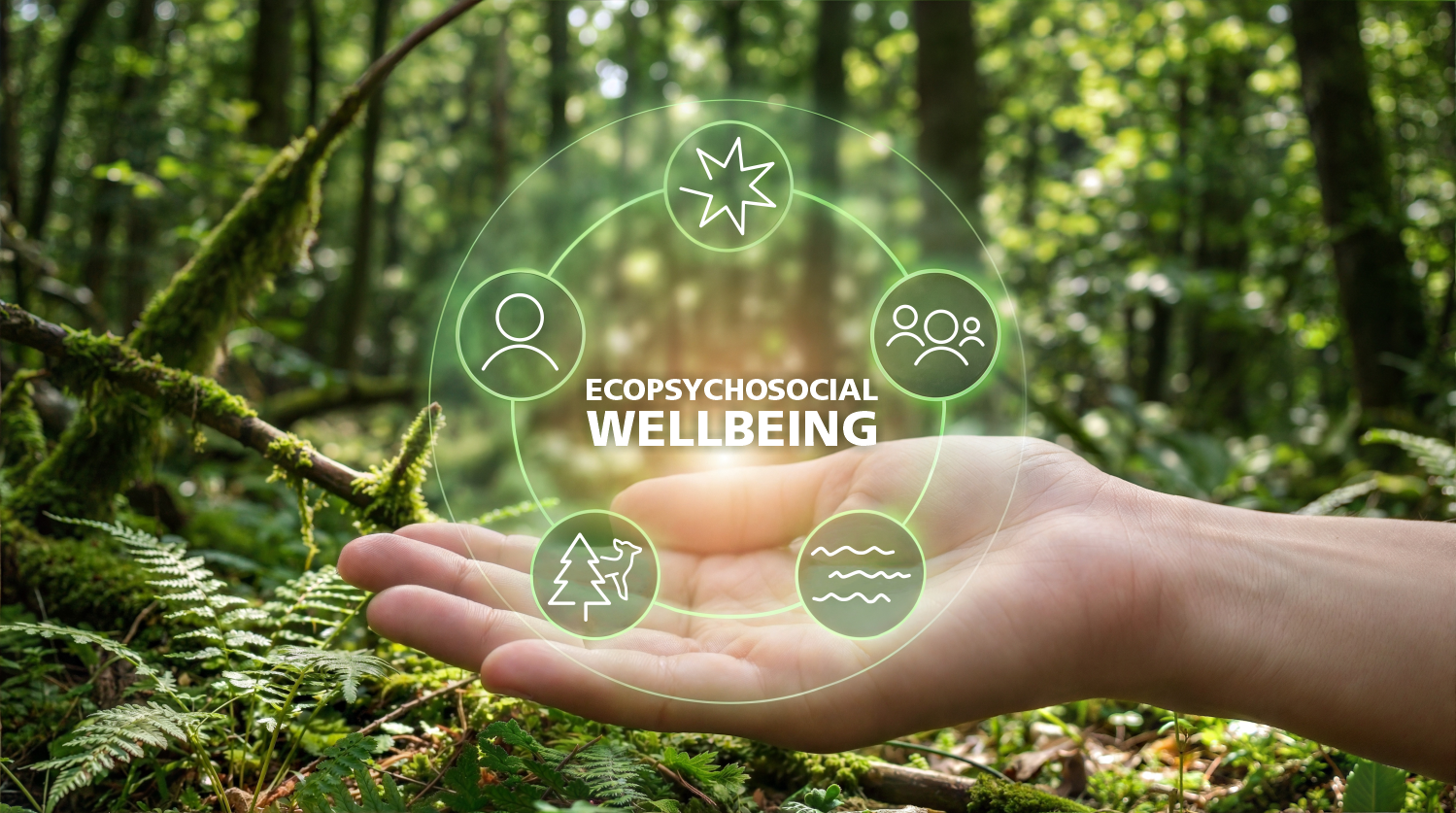
Ecopsychosocial wellbeing is about finding our way back into balance with life in a timeframe of lifetimes across generations. It's about the wholeness of life in interrelationship: with spirit, with self and one another, and with all life – the land, water, plants, animals – to ground ourselves.
We have agency to enact ecopsychosocial wellbeing. It's both in our hands and part of a Living Flow that we inherit and then gift as our legacy.
As part of the great web of life, we humans are stewards – both caretakers and caregivers. Stewardship ripples through time. It's about embracing diligence and messiness as you work toward regeneration and coherence. It's the greatest lesson you might ever learn in life: it's not about you. Therein lies wellbeing. Care for all of Earth's life is the most ancient, worthy, and meaningful responsibility of humanity as the consciousness of the planet. A steward knows that when you tug on any one thing, you find it attached to everything else.