
The stadium wave is a synchronized crowd movement during which seated spectators briefly stand up, raise their hands, and sit back down in sequence, creating a moving ripple effect through the stands. It's a human Living Flow. What if we could do that around the planet, in longer and longer bursts, as one ripple prompts many others?
A ripple effect is when one action starts a chain reaction, creating a series of second, third, nth-order occurrences – many that may be unexpected – that spread outward. The stadium wave is an embodied, visual human example. Ripple effects happen in natural ecosystems when, for example, a keystone species is reintroduced and over time the health of the whole area improves. The story of Bioregional Earth is very much about creating synchronous cascades of resiliency in the face of cascades of collapse. In complexity, synchronicity is the simultaneous occurrence of events or thinking that feel meaningfully related, though they may not have a direct, discoverable causal connection. The Ripple Strategy for planetary synchronicity is a main strategy in Living Flows, along with the Dandelion Strategy. The groundwork has been laid over the last several years by the Legacy Project, a systems complexity research and education group and the Core Team in the Greater Tkaronto Bioregion (GTB). This isn't theory – it's already happening on the ground as we invite others to live into the story of Bioregional Earth.
Drawing on Natural and Social Science
Physics tells us that one way energy can move around is by forming waves. For example, the waves you see crashing onto a beach are formed by energy from the wind. Ripples in sand happens when the flow of wind or water exerts a dragging force on loose sediment grains. And the ripples you create in a pond when you throw a rock are small waves carrying away the energy from where you threw the rock. The ripple travels away from your rock – a bit like a human wave around a stadium.
Though we can't see them, light and sound also move in waves. We have brain waves that are continuous rhythmic patterns of electrical activity across the brain, and we have neural ripples which are brief, high-frequency bursts of synchronized electrical activity in the brain that play a vital role in memory, learning, and cognitive processing.
The human wave in a stadium is a little different than the physics of water waves or the neuroscience of brain waves because it happens in the context of pyschology and sociology. Nothing "forces" the people to stand up. They do so because we're social creatures, take cues from others, feel responsibility and want to be part of the group. We respond to the signals we perceive around us.
A tree, for example, adapts and evolves based on signals from its environment – how much water falls, the nutrients available from the soil, the consistent pattern of the wind, other trees or objects it's sharing a space with – all the while following its primary dynamic of growing toward the sun. In the same way, humans are shaped by and shape the place they live, their bioregion, AND they are shaped by the social signals around them from other humans. In a time of polycrisis, the social signals become even more important for sensemaking how to move forward in a way that matters. For a tree and a person, every signal creates a ripple with no logical end. In systems complexity, we recognize that every issue, situation, or phenomenon exists within multiple contexts simultaneously. These contexts are interwoven, each influencing and being influenced by the others, a rippling swirl of causalities moving backward and forward in time.
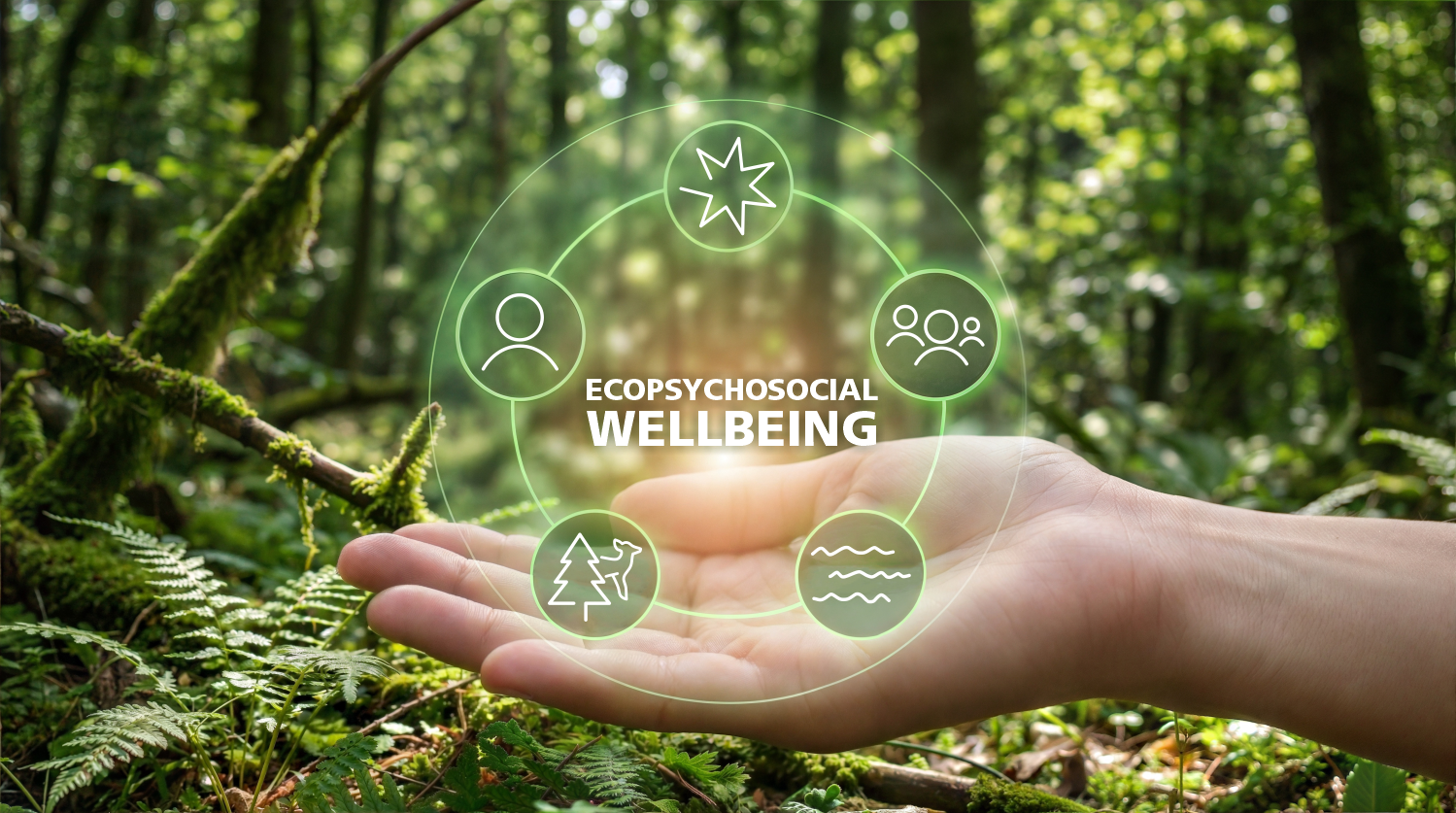
We've been experimenting with rippling both within the Greater Tkaronto Bioregion and across bioregions. Interesting and unexpected synchronicities have emerged. While we can't "control" the ripples, we're cognizant that every ripple starts in right relationship for right story toward ecopsychosocial wellbeing. In other words, we keep our eyes on a North Star.
There's a dimension of spirit involved here, especially as the work interacts with Indigenous worldviews and knowledge. Says Zitkala-Ša, a Yankton Dakota writer, "The voice of the Great Spirit is in the rippling of waters." The concept of the ripple effect, though not named as such, is deeply woven into Indigenous worldviews regarding connection, responsibility, and time. Indigenous philosophies teach that humans, animals, plants, and the elements form one living network, so every action matters. Like a stone dropped in a pond, every choice creates waves that affect the whole system. And decisions made today must be evaluated by how they will impact descendants seven generations into the future – current actions ripple through time to cause distant waves.
What each of us does in our life ripples through eternity, which is the essence of legacy. You are in the living flows of the cosmos, the currents of unceasing change. Every moment you're alive links the infinite past with the infinite future. Be aware of both, and the present becomes profound. Some piece of ourselves, not necessarily our consciousness, but some piece of ourselves gets passed on and on and on.
Through the Ripple Strategy, we're throwing stones in the pond, and encourage you to throw your own stone. What if many people did that? The ripples would bounce off each other, spreading in new directions, growing as more people toss their stones in. And if we keep on doing it, who knows how far the ripples might reach in the end?
We're working to increase the number of regenerative places in the world and the depth at which they're able to work. Bioregions ripple out signals to encourage synchronicity. It's not cause-and-effect. It's about Living Flows – grounded and meaningful relationships between thinking, learning, and action that flow everywhere for right story.
Rippling from the GTB
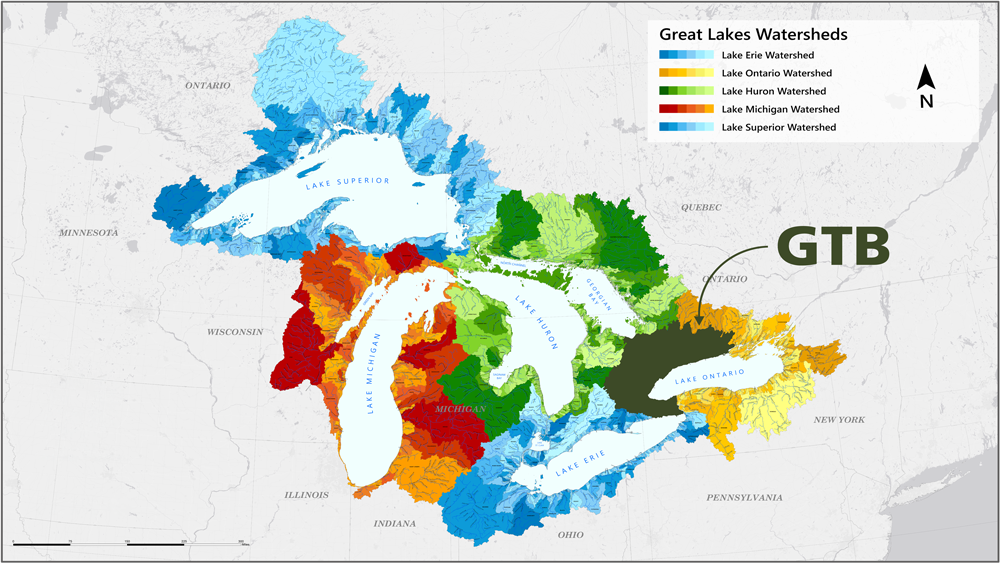
The Ripple Strategy is rippling out from the Greater Tkaronto Bioregion (GTB), into the Great Lakes Basin and Turtle Island (North America), and beyond. Signal by signal, we're flowing on-the-ground experience in social and ecological regeneration with knowledge systems interaction (i.e. best of Western science and Indigenous knowledge) for whole-system ecopsychosocial wellbeing. Who will pick up the signals? Who will ripple out from their own bioregion in synchronicity? Ripples emerging from many places – signals coming from everywhere – mutually reinforce and amplify each other for Earth regeneration.
The GTB, recognized as one of the most advanced bioregions in the world, was recently invited to submit an academic paper for an international urban sustainability journal. Susan Bosak, part of the GTB Core Team, explains more in this video about the GTB as a bioregion.
The GTB is 3 million hectares with a population of around 10 million people (25% of Canada's population). It was first defined by former Toronto Mayor and federal cabinet minister The Honourable David Crombie, with whom we created a documentary. In the 1980s, he led a Royal Commission on the Toronto waterfront. He learned about the term "bioregion" and realized that what happens on the waterfront is affected by the land around it. He expanded his work to look at the surrounding watersheds, and eventually published the seminal 1992 Regeneration report. Our work builds on his legacy.
The bioregion is both a way of doing things and a way of thinking. It's not a new concept. Indigenous peoples have long understood their connectedness to the ecosystem – the land, water, air, and other life. Thinking about the whole bioregion helps focus attention on the interdependencies.
— David Crombie, Regeneration report
The GTB is nestled in the Great Lakes Basin. This is significant to planetary flows because the Great Lakes have 21% of the Earth's fresh surface water. The Great Lakes system is fed by around 5,000 smaller tributaries and rivers, an amazing number of moving flows bringing the whole region alive. The Great Lakes drain into each other in a continuous chain from west to east. Niagara Falls takes all that Great Lakes water in one massive flow into Lake Ontario, which is where you find the GTB. The GTB itself has a geologic feature called the Oak Ridges Moraine. The Moraine sucks up rainwater like a sponge and slowly releases it to flow out and create 65 waterways across the GTB. So the GTB is defined by water. The Mohawk word "tkaronto" means "where there are trees in the water."
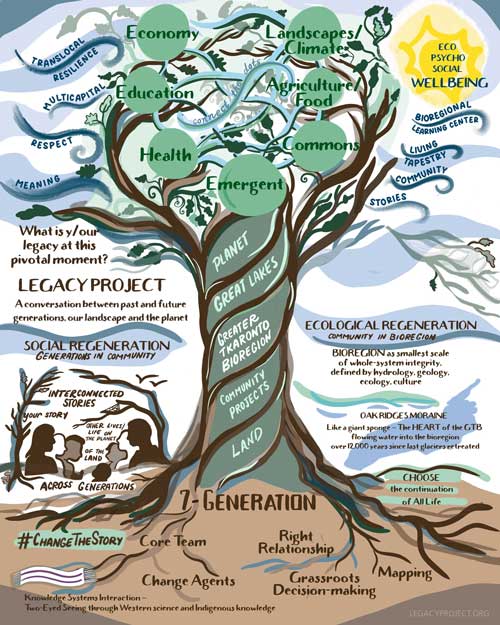
In the GTB, we talk about the work as growing a Tree of Life. The tree trunk in this image fractally scale-links everything into and out of the bioregion as the smallest actionable scale that maintains whole-system integrity.
You can see both social and ecological regeneration to the left and right of the tree trunk, with a strong intergenerational dynamic.
The goal (sun in top right) is ecopsychosocial wellbeing – "I" can't be okay unless "we" (family, community) are okay, and we can't be okay unless all living systems around us are healthy. #ChangeTheStory.
Grounding the entire tree is Knowledge Systems Interaction – bringing together the best of Western science and Indigenous knowledge. This is foundational to all the work in the GTB. From an Indigenous view, we need to be in right relationship within Natural Law. This means all our work needs to be grounded in and informed by the land. When we're in right relationship with the land, we learn how to be in right relationship with ourselves and each other.
In the branches of the tree are the thematic project clusters of activity, always in an emergent state affected by and creating various flows. In the GTB, we ripple across themes and between themes, using various strategies that bring otherwise fragmented groups together into project clusters.
Down in the roots, the Legacy Project is the Core Team. We also have fellow Stewards being trained in real time on the ground, learning to be in right relationship (with themselves, others, and the land). These Stewards, as they live more and more into right story, start to grow into the role of leads in the various project clusters, which becomes the seed for grassroots decision-making and governance. Where we can, we try to provide a basic income to free these Stewards from the existing system as much as possible. We also use flow funding to support people in project clusters in critical moments. Money always tries to flow toward right story.
People often say we have to work at the speed of trust. We believe that the bioregional work ripples out at the speed of life – sometime fast, sometimes slow, different flows to different places in the right context at the right time.
A Bioregional Learning Center (BLC) is the anchor of a bioregion. The GTB Bioregional Learning Center is part of the Dandelion Strategy. It helps inform and create a new/renewed context for everything else. It helps people learn/relearn how to live in and regenerate their place. It brings together education, research, community building, regenerative practices and, most important of all, storytelling in the mythic, intergenerational sense. We're carefully weaving together a tapestry of projects, existing and new, informed by bioregional learning. They enable experimentation and practice, and over time, new practices. This becomes a portfolio of social and ecological regenerative projects, which are strategically interconnected to enable a circulation of different flows – money, experience, knowledge, materials, stories. This multiples the effect of any single project in the context of a larger story of bioregional mind, which loops back to the foundation of ongoing learning through the BLC.
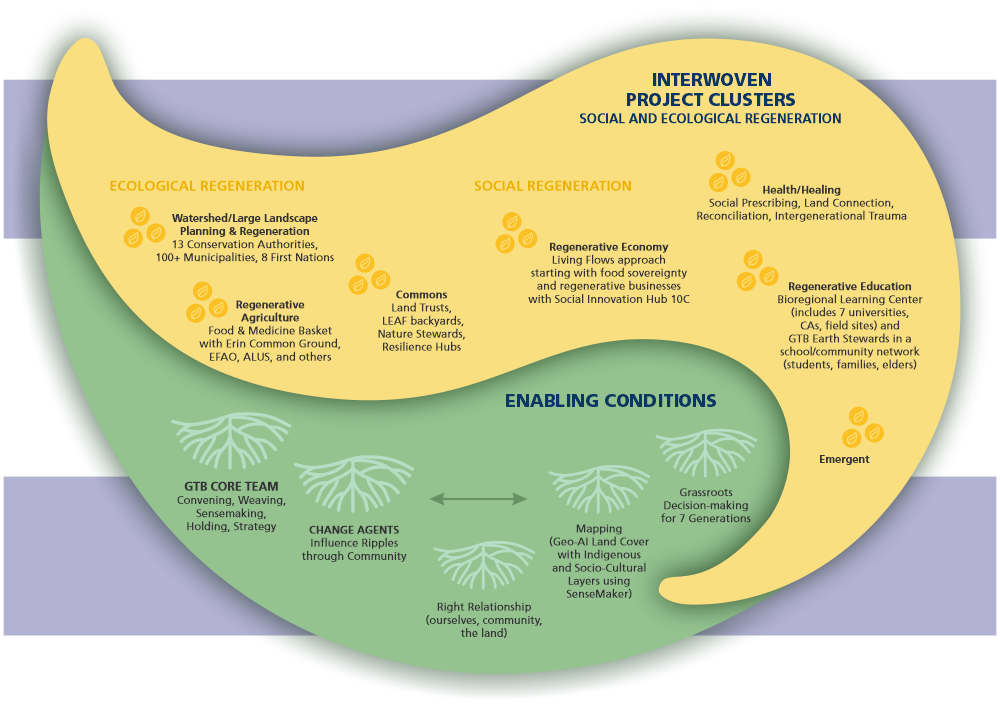
The enabling conditions and project clusters in the GTB are interconnected and continously interacting. In the background, the two purple lines represent knowledge interaction between Western science and Indigenous knowledge, critical if we want to shift from wrong story to right story and meet this moment in human history.
We're doing whole-system work, which means we're not looking to fund individual isolated projects, but a portfolio of interconnected projects for both social and ecological regeneration. We have projects around watershed and landscape regeneration, regenerative agriculture, the commons, regenerative economy, health, and education. Think of everything in a protected cocoon of amniotic fluid with interconnecting flows across the project clusters. Everything informs and multiplies the effect of everything else. This is part of the alchemy of this approach – the weaving done by the Core Team in concert with the energies and knowledge flowing across project clusters. This is constantly emergent and fluid, as much craft as science.
Between the enabling conditions and project clusters, we’re able to design simultaneously for conditions, interactions, and monitoring. At the scale of the bioregion, we’re able to nurture conditions of right relationship, while supporting interaction between all the project clusters in an agile way for real-world emergence (and pivoting), all the while monitoring for real-time sensemaking using Developmental Evaluation – what? so what? now what?
Rippling Around the Planet
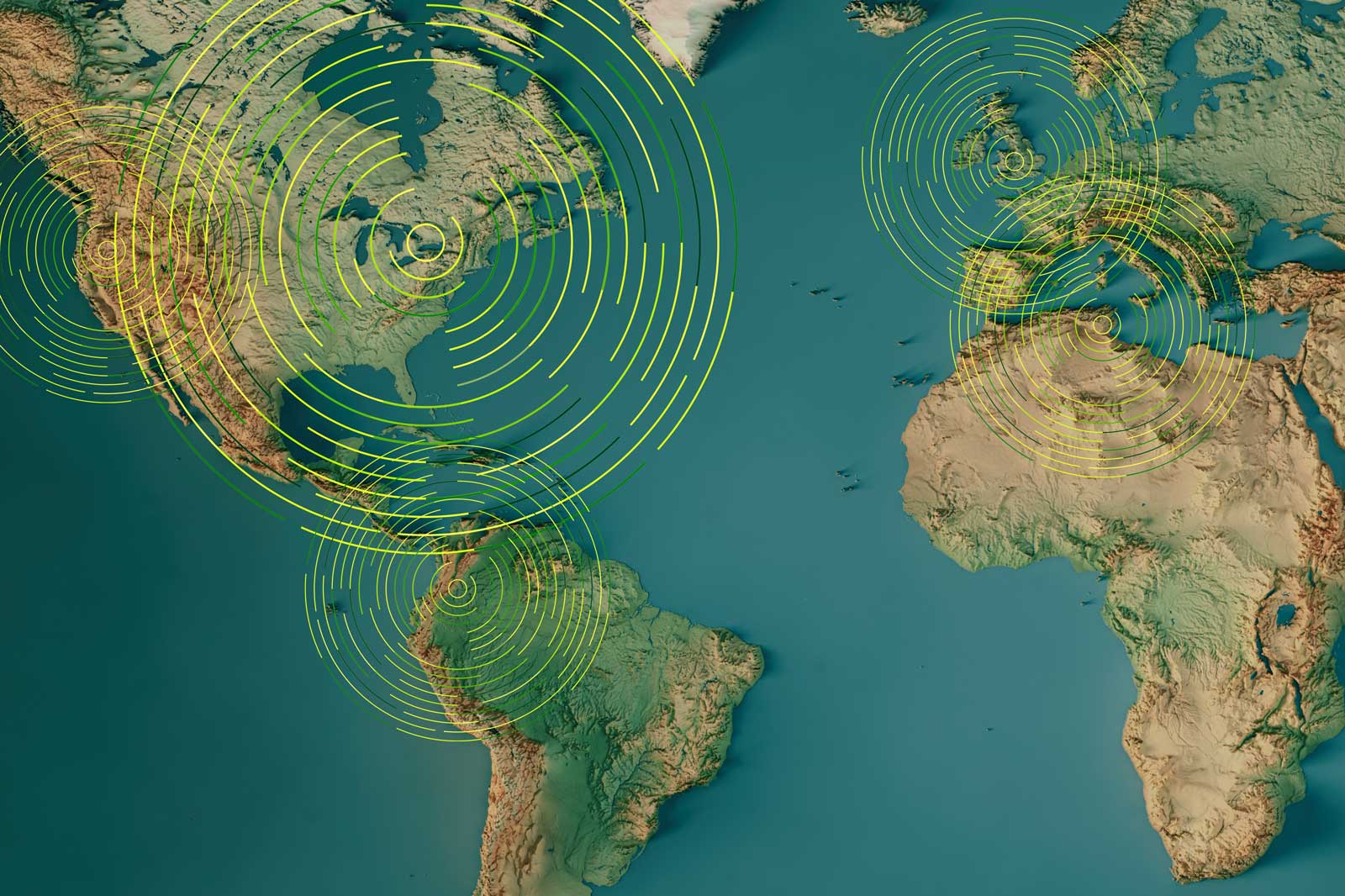
We're rippling out from the GTB as other regions pick up the signals and themselves ripple out in synchronicity. We're sharing learnings and strategies for rippling within a bioregion, as well as across bioregions. We're already working to support other Great Lakes bioregions as well as an Indigenous Great Lakes Network. And we're rippling out knowledge across various themes, including Knowledge Systems Interaction, whole-system complexity, bioregional mapping, storytelling, and intergenerational learning. The Ripple Strategy is working.
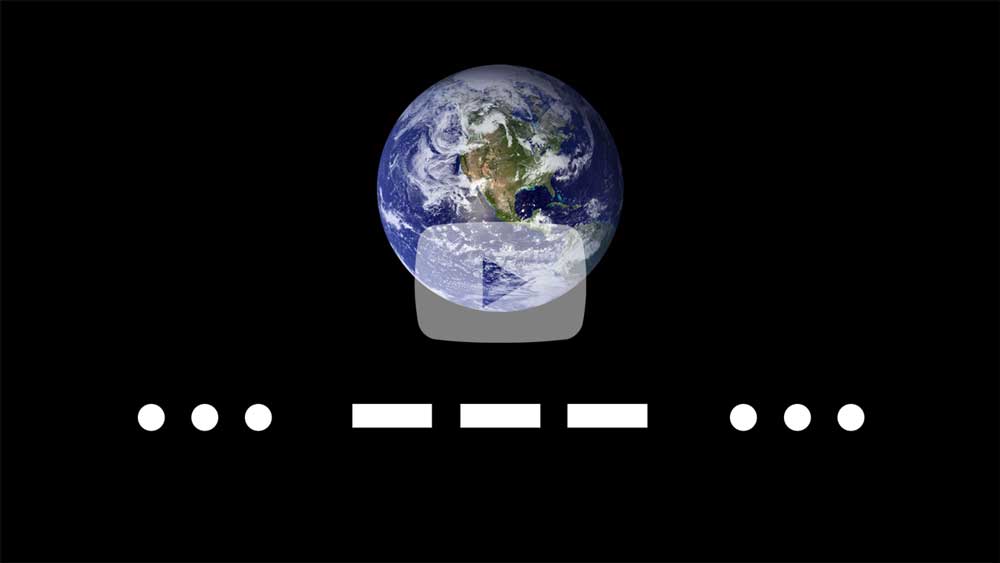
The first signal we rippled out from the GTB was an SOS – human to human. Unlike ripples in water, we as human beings can learn the patterns from nature to give rise to holistic systemic patterns at the bioregional scale. We can weave and integrate the cultural and ecological heritage of each life place through coordinated efforts. #ChangeTheStory.
One stone thrown into the water is never the end of the story. Ripples move outward, sometimes far beyond sight. Feel into the Ripple Strategy. Start thinking about the things you do each day as potential ripple-effect moments. It only takes 20 people to start the wave in a stadium of 100,000.
Join us.